
Archive Record
Images
Additional Images [15]
Metadata
Catalog Number |
2012.050.257 |
Object Name |
Clipping, Newspaper |
Date |
07/13/1921 |
Scope & Content |
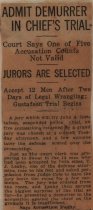
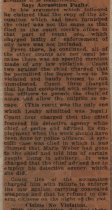
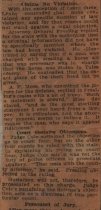
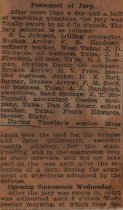
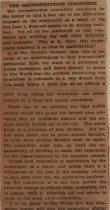
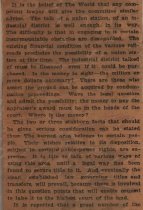
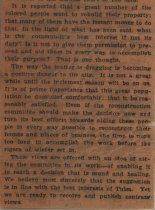
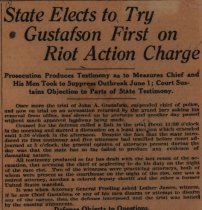
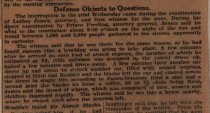
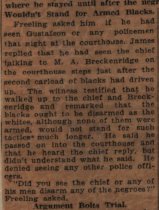
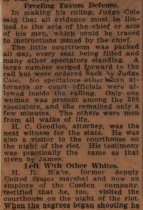
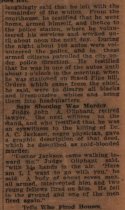
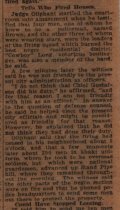
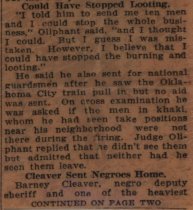
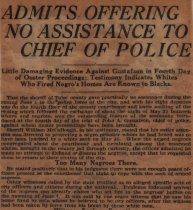
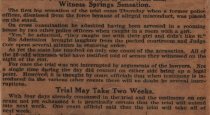
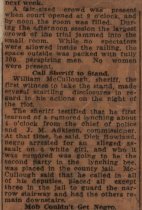
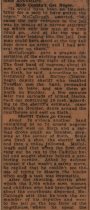
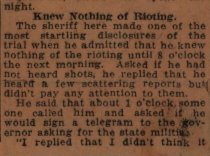
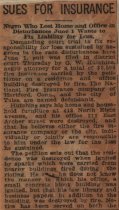
Five newspaper clippings from the Tulsa Daily World published July 13, July 14, and July 15, 1921 and attached to an album page. The first clipping, published July 13, is entitled "Admit Demurrer In Chief's Trial." The article reports that a jury will try suspended Tulsa Police Chief John A. Gustafson upon five counts brought against him by a grand jury. The oounts are connected with Gustafson's actions during the 1921 Tulsa Race Massacre. The article also reports the defense attorney's objection to four of the five counts. Judge Redmond S. Cole sustained the objection on one count. The article also contains a list of the jurors and their occupations. The second newspaper clipping, published July 13, 1921, is entitled "The Reconstruction Committee." This editorial reports upon the lack of accomplishments thus far of the Reconstruction Committee appointed by Tulsa Mayor Thaddeus Daniel Evans and the Tulsa County Commissioners. The committee was appointed to deal with the issues of reconstruction following the destruction of the African American section of Tulsa in the Tulsa Race Massacre. The editor states that "there can be no question but that public opinion would like to see the burned area converted into an industrial district and the negroes moved farther out of the city." The editor states that the Reconstruction Committee must make the more serious decision of making full reparation for losses sustained by property owners. The editor questions talk of converting the burned African American section into an industrial section, when reparations have not yet been made to property owners. The editor states that legal title to the area must be obtained first. The third newspaper clipping, published July 14, 1921, is entitled "State Elects to Try Gustafson on Riot Action Charge." This article reports upon the trial of suspended Tulsa Police Chief John A. Gustafson facing five counts of criminal conduct, including one felony count of conspiracy. The article states that the trial has thus far focused on the charge of Gustafson's dereliction of duty during the Tulsa Race Massacre on the night of May 31, 1921. The article reports testimony given in court on Wednesday, July 13, 1921, which provides a description of the evens that took place at the Tulsa County Courthouse on the evening of May 31, 1921. Witness Luther James stated that on the night of the 31st, approximately 1,500 to 2,000 people gathered in the streets due to curiosity of the rumor that a black man was to be lynched. James reports the arrival at the courthouse of at least three cars filled with armed African Americans between 9:30 and 10:00 p.m. Upon the arrival of the last car, the African Americans filed across the street to the courthouse and a shot was fired. James reports a volley of some fifty to seventy-five shots at which time the crowd of spectators dispersed quickly. The article reports that the trial was interrupted when the defense entered an objection to the prosecution's question of whether or not Chief Gustafson had ordered the disarmament of the African Americans. Judge Redmond Cole eventually sustained the objection and stated that "all evidence must be limited to the acts of the chief or acts of his men, which could be traced to instructions issued by the chief." The article also contains information from the testimony of H. R. Blake, former Deputy United States Marshall. Blake stated that that about 100 automobiles were volunteered to the police, and in these cars armed citizens "patrolled the city under police direction." The report also states that Judge John A. Oliphant testified about the murderous killing of African American doctor A. C. Jackson, which he witnessed firsthand. Oliphant also revealed startling testimony that a band of four men, which included a Tulsa policeman named Brown, were responsible for starting the blaze that burned the African American business district. Oliphant gave the testimony that he did not think that Chief Gustafson did his duty during the violence. The back of the newspaper clipping contains the continuance of the article. It states that African American policeman Barney Cleaver was the last to testify on Wednesday. He stated that he was able to persuade the first group of African Americans at the courthouse to leave. He states the shooting started later before he could arrive on the courthouse steps. The newspaper clipping also contains the arguments of defense attorney A. F Moss with regards to the actions of disarming African Americans as directed by Chief Gustafson. The fourth newspaper clipping, published July 15, 1921, is entitled "Tulsa Sheriff Slept Through Tulsa Riot; Admits Offering No Assistance To Chief of Police; Little Damaging Evidence Against Gustafson in Fourth Day of Ouster Proceedings; Testimony Indicates Whites Who Fired Negro's Homes Are known to Blacks." This article reports upon court testimony from the fourth day of the trial of suspended Tulsa Police Chief John A. Gustafson, who faces five criminal counts, including one felony charge of conspiracy. The article reports that the outstanding feature of the day's testimony included the fact that Tulsa County Sheriff William McCullough [sic, Willard M. McCullough] gave "practically no assistance during the rioting June 1 to the police force of the city." In his testimony, McCullough stated that his full attention was on protecting the African American prisoner, Dick Roland, from a potential lynch mob. The article also states that several African American witnesses could identify Caucasians who set fires to homes in the African American community on the morning of June 1, 1921. The article then provides more precise testimony given by Sheriff William McCullough concerning the gathering mob at the courthouse on the evening of May 31, 1921. He stated that he spent the night in the courthouse protecting the prisoner and "knew nothing of the rioting until 8 o'clock the next morning." The article also contains a summary of the testimony of E. L. Wheeler, an ex-service man who volunteered his service during the violence to command a machine gun he obtained from Inspector of Police C. W. Daley. He states that a young man shot him when he tried to get a group of Caucasian men to stop shooting. The article reports that African Americans G. E. Gurley [sic, O. W. Gurley] and V. B. Bostick also testified. Gurley states that during the violence his hotel was burned and he fled and hid in the basement of the Dunbar School until it too was burned. Bostick testified that several armed men under the supervision of an officer in a traffic uniform transported his family to the detention center at Convention Hall. As they were leaving their home the man in the uniform prepared to burn the house by pouring oil on the front porch. The article clipping also contains a summary of the testimonies of Fred S. Cook, H. H. Townsend, and C. O. McInturff. The fifth newspaper clipping, published July 15, 1921, is entitled "Sues For Insurance." This article reports that African American attorney G. W. Hutchins filed suit in district court demanding a court trial to obtain insurance money on property he lost as a result of the devastating fires during the Tulsa Race Massacre on June 1, 1921. Hutchins lost his home and furniture located at 412 North Elgin Avenue and his law office and law library at 312 East Archer Street. In the suit, Hutchins named two defendants: the National Fire Insurance Company of Hartford, CT and the City of Tulsa, OK. |
Search Terms |
Dunbar School editorials fires grand juries Greenwood District insurance companies law enforcement lawsuits North Elgin Avenue Oklahoma National Guard Reconstruction Committee trials Tulsa County Courthouse Tulsa County Sheriff Tulsa Police Chiefs Tulsa Police Chiefs Tulsa Police Department Tulsa Race Massacre |
People |
Adkison, James M. Bart, H. E. Blaine, George H. Blake, H. R. Bostick, V. B. Bowman, E. J. Breckenridge, M. A. Cleaver, Barney S. Cole, Redmond S. Cook, Fred S. Daley, C. W. Edwards, Frank Freeling, S. P. Freeman, J. R. Gibbons, Ira Goldsberry, John Goodloe, H. C. Gurley, Ottaway W. Gustafson, John A. Hardesty, F. E. Horrigan, J. B. Hutchins, G. W. Jackson, Andrew Cheesten James, Luther Johnson, S. L. Kelly, W. S. Leahy, T. J. McCullough, Willard M. McDonnell, J. T. McGee, J. W. McInturff, C. O. Moss, A. F. Oliphant, John A. Price, H. V. Randolph, A. J. Richards, J. D. Roland, Dick Scott, F. M. Setser, Dan M. Townsend, H. H. Weber, Marie Wheeler, Edward L. |