
Object Record
Images
Metadata
Catalog Number |
2025.113.002b |
Collection |
Tortorici, Ruth |
Object Name |
Glass, Drinking |
Date |
03/15/1976 |
Description |
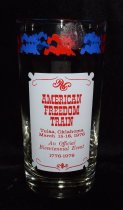
Bartlett-Collins drinking glass measuring 5.5" tall x 2.375" in diameter and commemorating the bicentennial of the American Freedom Train. The glass design contains a central white rectangle with the bicentennial event information and the rim contains small illustrations of a train transitioning into a waving flag, alternating in blue and red. American Freedom Train The American Freedom Train was a twenty-six-car railroad train pulled by a restored steam locomotive that visited all forty-eight contiguous states in the nation during a twenty-one-month period from April 1, 1975 to December 31, 1976 to help celebrate the bicentennial of the United States. The train included twelve display cars filled with more than 500 items of Americana. Some of the historic artifacts included George Washington's copy of the Constitution, the original Louisiana Purchase, Judy Garland's dress from "The Wizard of Oz," Joe Frasier's boxing trunks, Martin Luther King's pulpit and robes, and a moon rock. Bartlett-Collins Company The beginning of the Bartlett-Collins Company of Sapulpa, Oklahoma is traced back to November 1914, when three parties signed a contract for the creation of a new glass plant. The first party was Harry Ulysses Bartlett (1863-1931), an oil operator and real estate owner in Creek County, Oklahoma. The second party was George Fulton Collins, Sr. (1872-1939), president of Premium Glass Company, which in 1912 moved from Coffeyville, Kansas to Sapulpa, Oklahoma. The third party in the contract was the Sapulpa Commercial Club. The contract required the construction of a glass plant costing $60,000, which was to operate for a period of five years and employ 125 men with an annual payroll of $66,000. The Sapulpa Commercial Club agreed to relinquish the former site of the Biron window glass plant, as well as pay a $15,000 bonus to Bartlett and Collins ten days after the completion and operation of the glass plant. On Monday, June 28, 1915, employees produced the first glassware in the new Bartlett-Collins plant, located southeast of downtown Sapulpa, a location that later became 620 South Linden Street. The following evening, approximately 2,000 citizens of Sapulpa and other visitors toured the new plant which included a twelve-pot furnace and six-ring continuous tank. The management did not expect such a crowd, and plant employees quickly gave away the 350 souveniers that were prepared for the event. At the time of the opening, the plant was advertised as the largest of its kind in the west. It was the only glass factory in Oklahoma at the time making high-grade glassware using the pot furnace method instead of the tank method. The plant produced both blown and pressed glassware. The site consisted of four, immense buildings, the factory building being the largest. Other areas included shipping, sorting, office, and warehouse space. After an erroneous press release stated that Blacks would not be hired, plant management refuted the statement and announced that Bartlett-Collins would hire Black workers. The management of the new plant sought experienced glass workers for the advanced positions. Edward Rowland of Indiana, Pennsylvania was hired as the factory manager. He had thirty years of experience producing table glassware. Walter Daly was the foreman of the mold and machine shops. He came to Bartlett-Collins from the Heisey plant at Newkirk, Ohio. J. F. Holland served as superintendent. Co-owner George Collins remained active in charge of the entire plant. The official formation for the Bartlett-Collins Company with the State of Oklahoma occurred July 15, 1915. The company executives were as follows: H. U. Bartlett, president; E. R. Rankin, vice-president; and George F. Collins, secretary-treasurer. Bartlett-Collins Company made a wide variety of glassware during the decades. These items included the usual tableware items of plates, saucers, bowls, goblets, tumblers, highball glasses, whiskey glasses, juice glasses, pitchers, cream & sugar sets, and salt & pepper shakers. Other items included cookie jars, chip & dip sets, vases, ash trays, lamp bases, kerosene lamps, candle holders, and furniture caster cups. The company produced these blown and pressed glass items in a large variety of glass colors, some featuring cut-glass or etched designs, and some with hand-painted decoration. In 1982, Lancaster Colony of Columbus, Ohio purchased the Bartlett-Collins Company. Lancaster Colony also owned Indiana Glass Company. Upon the purchase, the company invested $3.5 million in renovations for the Bartlett-Collins plant in Sapulpa. In 2007, Anchor Hocking of Ohio purchased Bartlett-Collins. The following January, Anchor Hocking announced plans to close the Bartlett-Collins plant. The closure meant the loss of employment for approximately 425 workers in Sapulpa. In June 2008, the plant ceased production after ninety-three years of producing glassware. |
Search Terms |
American Freedom Train Bartlett-Collins Company commemorative glasses drinking glasses glassware trains U.S. bicentennial |